Short horn cattle by Bates Thomas 1775-1849
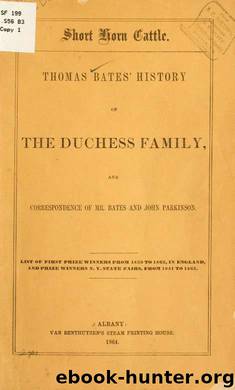
Author:Bates, Thomas, 1775-1849. [from old catalog]
Language: eng
Format: epub
Tags: Shorthorn cattle
Publisher: Albany, Van Benthuysen's steam printing house
Published: 1864-03-25T05:00:00+00:00
SHORT-HORN " SENIOR WRANGLERS.
UiidcM- tin's title we present the public with a list of the winning Shorthorns in the first class of bulls and cows respectively, at the yearly meet-ing-s of the Royal Agricultural Society of England. The want of such a list, accompanied by explanatory comments, has long been felt by the writer of the present article, and has no doubt been equally felt bj' others.
We restrict our labors to the first class of bulls and the first class of cows; partly because an extension of the plan would multiply materials to an inconvenient degree, but chiefly because the most significant and instructive lessons result from an exhibition of aduTt specimens of the Short-horn tribes. The character of calves (purity of blood granted) depends incalculably upon the skill of those who rear them; heifers and young bulls repeatedly excite expectations which are not realized in their subsequent history-; but Short-horns matured by time and growth may be accepted as reliable, though, perhaps, favorable samples of the several families to which they belong, and invite judgment on the strength of properties fully developed and unmistakably apparent. Some sorts improve as they approach the point of maturity, soine grow worse; in either case, the mature animal is the only fit example and the only adequate criterion. Our objections to one of the most fashionable Short-horn families of the day are founded upon the fact that the members of that family, as adults, seldom, verify the promise of their state of veal. Yet amongst the idolatries in vogue, calf idolatry is becoming notorious. The gold medal has endowed it.
The value of the animals exhibited is far from being merely individual. If this were all, our shows would lack interest and profit. But the winning Sliort-horns are, or ought to be, representatives, and herein consists their importance. The herds which have produced them are supposed to be capable of producing others like them; if the same blood is at work the same "points" may be expected. As a general rule these conclusions will be established by facts. The Short-horn herd which sends forth a Shorthorn winner may be safely looked to for the supply of good Short-horns, and accordingly a first prize is an advertisement equally beneficial to the owner of the successful animal and to Short-horn breeders who desire fresh blood.
OXFORD, 1839.
Duke of Northumberland (1940), bred by and the property of Mr. Bates.
Oxford premium cow (Herd Book, V., p. 152), bred b^' and the property of Mr. Bates.
Duke of Northumberland was the result of a combination of R. Ceiling's "Princess," and C. Colling's "Duchess" blood, in the proportion of three-fourths of the former and one-fourth of the latter. Down to the time when the two strains became united in the person of his dam, Duchess 34th, in-
Download
This site does not store any files on its server. We only index and link to content provided by other sites. Please contact the content providers to delete copyright contents if any and email us, we'll remove relevant links or contents immediately.
The Secret History by Donna Tartt(19291)
Goodbye, Things by Fumio Sasaki(8640)
Wonder by R. J. Palacio(8165)
Turbulence by E. J. Noyes(8112)
How to Be a Bawse: A Guide to Conquering Life by Lilly Singh(7545)
The Thirst by Nesbo Jo(7002)
Kaplan MCAT General Chemistry Review by Kaplan(6986)
The Testaments by Margaret Atwood(6971)
The Last Wish (The Witcher Book 1) by Andrzej Sapkowski(5516)
Spare by Prince Harry The Duke of Sussex(5252)
The Body: A Guide for Occupants by Bill Bryson(5173)
The Rules Do Not Apply by Ariel Levy(5019)
On Writing A Memoir of the Craft by Stephen King(4995)
Audition by Ryu Murakami(4976)
The Doodle Revolution by Sunni Brown(4822)
1578 Plant Pattern Recognition Receptors by Unknown(4784)
Gerald's Game by Stephen King(4705)
Adulting by Kelly Williams Brown(4620)
Millionaire: The Philanderer, Gambler, and Duelist Who Invented Modern Finance by Janet Gleeson(4537)
